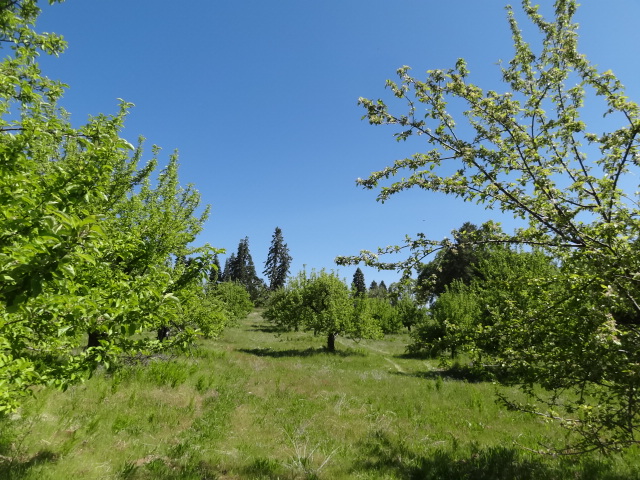
The Butterfly Farm was owned by the Hewlett Family in 1910 and they raised butterflies in the apple orchard – see article below. The property known as “The Old Mac Place” was purchased by Alonzo Hayes, Elsie’s father in 1904. Elsie and her husband, Jack Roberts named it Planwydd, from Jack’s middle name. He was Welsh and Planwydd translated means ‘Plantation’.
Since the mid 1970’s Tom Burton has owned this beautiful land. It is several different parcels now and in escrow with some new families looking forward to enjoying this beautiful land.
[From: High Country Magazine late 1960s or early 1970s ]
PALOMAR; ITS PAST
By BARBARA J. JACKSON
ASK ANY CALIFORNIAN what Palomar Mountain is famous for, and he’ll immediately tell you that it’s the home of the world’s largest telescope. But ask him what else he knows about the mountain and chances are he’ll stammer something incomprehensible and change the subject.
To the majority of Californians, Palomar Mountain came into existence in 1934 when it was chosen as the home of the giant telescope. The construction problems brought the state’s attention to this remote outback, just fifty miles northeast of the busy port of San Diego.
But long before that happened, it was from the oak-studded slopes of Palomar that the Luiseño Indians obtained many of the acorns with which they made the mush they called wee-wish, and it was from the pine-clad highlands of the mountain that the first Spaniards obtained timbers for the missions at San Luis Rey and Pala.
At that time the mountain was the home of countless wild pigeons so the Spaniards called it Palomar, or nesting place of the pigeons. But the Spaniards never lived there, and for many years it remained an exclusive summer resort of the Indians.
Palomar Mountain, however, was home to a number of American settlers long before the coming of the telescope. Birch Hill, near the summit of the “Highway to the Stars,” was homesteaded by two of the greenest young Englishmen ever to come to San Diego County. Their log cabin was almost completed when a neighbor happened by. “Why doesn’t your cabin have a door and windows?” the neighbor asked.
“We’ll cut the door and windows out after the cabin is finished,” replied the greenhorns. But they never did. They always climbed in and out using a ladder and crawling through a small opening under one gable.
One day a neighbor asked Harry Birch to grease a wagon for him. Obligingly, the young Englishman took the can of grease and went to work. Soon, however, he was back asking for more.
“Why, Harry, I gave you enough grease to grease a dozen wagons. What happened to it?” asked the neighbor.
Harry looked puzzled. “Well, Sir,” he replied, “I guess I put it on too heavy. I didn’t have enough to quite cover the tongue.” It was several years before Harry Birch lived down the joke.
TODAY Palomar Mountain has been claimed, surveyed, staked out, fenced off and “improved,” but the visitor will still find historical sites if he is willing to get his boots dusty. The easiest, although far from the oldest, place to find is the old butterfly farm. It’s located near the entrance to the State Park campgrounds, at the top of the mountain. Although the main ranch house has been torn down, four shingled cottages are still standing. A neglected apple orchard is located right beside the road. The apple ranch was bought in 1913 by Mr. and Mrs. W. F. Hewlett. The Hewletts had two children, Esther and a young boy. Since the neighbors lived far away, the children amused themselves by chasing and collecting the butterflies which abounded in the apple orchard.
One day Esther noticed a magazine article, Butterfly Farming. Curious, she wrote to the author and received the information she needed to raise her own butterflies. Soon the Hewlett children were in the butterfly business. Several years later the family left the mountain, but they stayed in the business, with a few changes. Instead of raising butterflies, they set up a family art business, putting original butterfly designs on lamp shades, trays, and other articles. The Hewlett women worked out many original crochet patterns of butterflies which have appeared in national needlework magazines.
ONE OF THE most interesting and beloved characters of Palomar Mountain was a scruffy old ex-slave. He was known all over San Diego County as Nigger Nate, or Uncle Nate. Today he’s referred to by his full name, Nathan Harrison. One of the first roads to be built up the mountain was named for him, and for years it affectionately and officially carried the name Nigger Nate Grade. It’s still known locally by that name, but officially has been renamed Nathan Harrison Grade. Today it’s a favorite trail, bike and jeep road and gives the hardy adventurer a superb and unique view of the rich citrus groves in the valley below.
Nate lived at a bend in the road. The site of his cabin is now marked by a four-foot rock monument dedicated to “the first white man on the mountain.” This was the way Uncle Nate referred to himself. He meant he was the first non-Indian to live there.
For years Uncle Nate was “seventy-six years old next New Years.” Then one day some young rascals got him drunk and told him he was “one hundred and seven years old last Fourth of July,” and that was his age until he died.
AT THE TOP of the Nathan Harrison Grade is Doane Valley. Much of the valley is now occupied by the State Park campgrounds, but it was originally named for Mr. George Doane, the Romeo of the mountain. After a far-reaching but unsuccessful search for a “schoolmarm” bride, Doane advertised in a national publication and received a number of replies. He selected one, went to Louisiana and married her. Returning to his homestead at the top of the mountain with his new bride and her Negro maid, Doane stopped to introduce the women to Uncle Nate. Nate looked the women over carefully and turned to Mr. Doane. “So this here’s your new wife,” he drawled. Then in all innocence he blinked his watery old eyes, shifted a twig to the other side of his mouth, and asked, “Which one is the bride?”
PALOMAR MOUNTAIN has seen romance, but it has also seen tragedy. Dyche Valley, located at the east end of the mountain on State Highway S6, was the scene of the murder of the original homesteader there, Long Joe Smith. Long Joe was well-liked, and for years Palomar was known as Smith Mountain in his honor. The culprit who murdered him was an English seaman whom Smith had befriended.
It’s said that when the murder became known on the mountain the neighbors promptly captured the fellow and arranged to meet the constable at nearby Warner’s Ranch so “the varmint could be brought to justice.” While several neighbors were inside the ranch house arranging the matter with the constable, the other neighbors, including Uncle Nate, “got on with the justice.” When the constable came outside to take charge of his prisoner he saw the fellow dangling four feet off the ground. Turning to the nearest group of men, he asked:
“What happened?”
Finally one of the men, with his hat in his hands, answered. “Well, I guess we orta’ve kept a better eye on him. This here fellow must’ve felt right sorry about murderin’ poor old Long Joe, and he got hold of a rope and hung his-self.” It saved the county the cost of a trial.
THE REMOTE ISOLATION which the early settlers of Palomar knew is broken today by a steady stream of campers and picnickers. The visitor can peer into the heavens at the observatory, or peek into the past on the wagon-rutted trails. But who can guarantee where the old trails lead?
Perhaps there are still. undiscovered cabins tucked away in the corners of Palomar Mountain, with more human interest stories hidden in them.
Lepidopterist Butterfly Magazine 1916:
For SALE : Perfect butter-flies and moths in papers. 15 species Lye. sonorensis, Colias barl)ara, Arg semiramis, etc., all from Palomar Mt., San Diego, Calif. Prices from 1 cent to 10 cents each. 100 pupa; of Lye. sonorensis at 5cents. each. Address: Esther P. Hewlett, Nellie, Calif.
Nellie (named after a gal who worked at the PO) was a Post Office on Palomar Mountain that was located in several different places. An old map shows, and the notes in a journal tell, that at one time, you went to Planwydd for your mail.

 Palomar Mountain News
Interesting story Bonnie. 🙂
LikeLike
By: rayunseitig on June 7, 2012
at 5:01 am